
Story · Anime Chronicle
Why trains carry time and goodbyes in anime: five films that teach you to read the platform
From the snow of 5 Centimeters per Second to Spirited Away’s sea railway, a spoiler-light reading of doors, seats, and windows as a language of distance and choice.
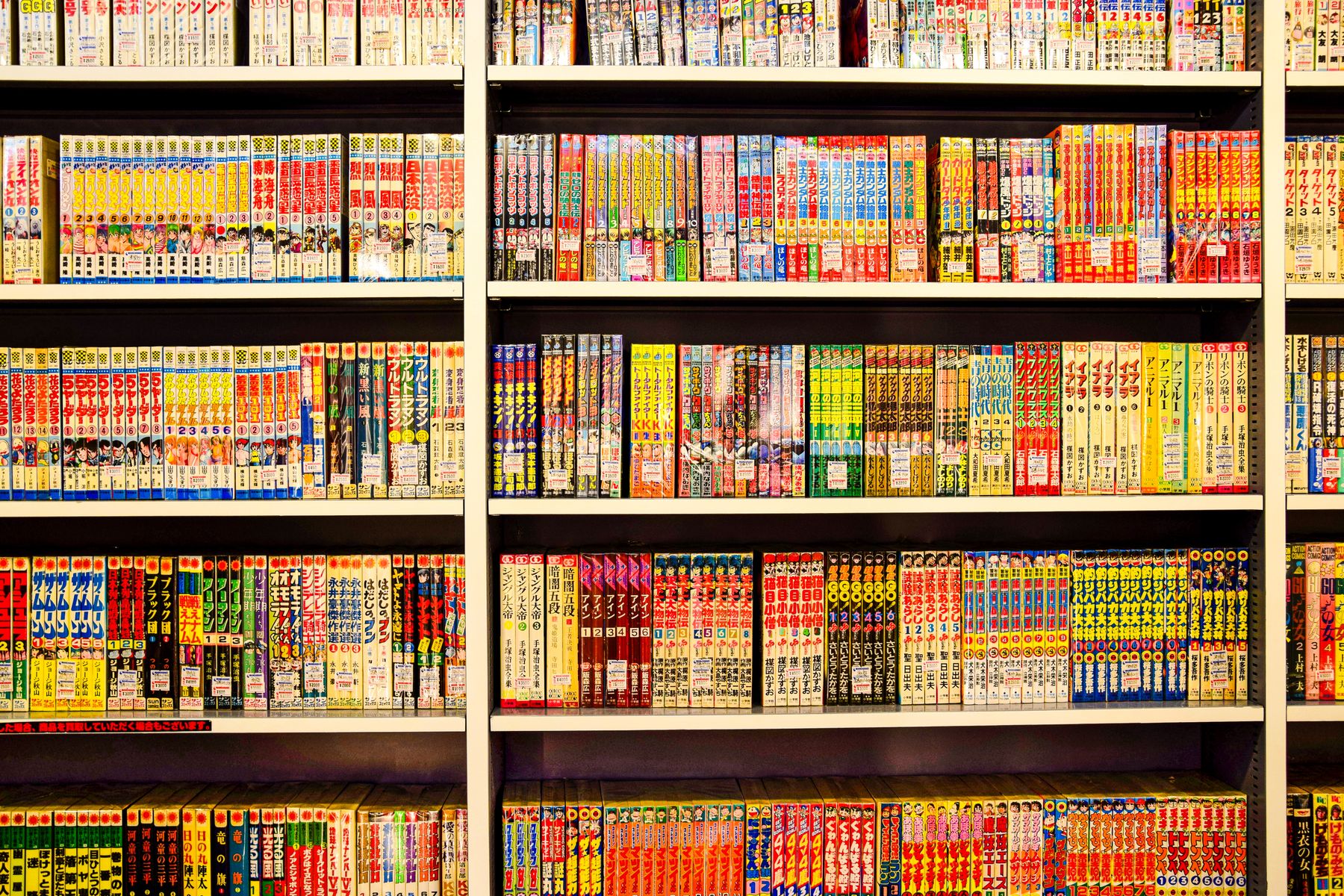
A real contextual photograph of a Japanese manga shop; not an anime frame.
Verified 8 August 2026: we checked the Japan National Tourism Organization’s public-transport guidance and official film pages from Studio Ghibli, Kyoto Animation, and the Makoto Shinkai Works portal. Release years and production credits are sourced; the shot analysis is our original, spoiler-light reading. We do not claim that every anime train carries one universal symbol, or turn travel etiquette into a stereotype about every passenger in Japan.
A daily train is a system of timetables, fixed routes, and shared seats; anime receives a ready-made dramatic machine. A character cannot pause it to finish a sentence, and a door open for seconds turns hesitation into a visible decision. A window overlays a face on a passing city; an announcement measures time that does not care how anyone feels. Simple customs—queueing, letting riders leave first, keeping voices low—also explain why one silent look across a carriage can hold tension. The meaning is not “mysterious Japan”; it is public time pressing against private feeling.
1. 5 Centimeters per Second (2007) — the train as a test of a promise’s patience. Takaki travels through snow that disrupts the timetable, and delays and transfers accumulate until time itself feels heavy. Arrival is not the only question; lack of control is the drama, with every station consuming part of the sentence he wants to say. Watch clocks, passing trains, and darkness behind glass. Distance becomes a duration rather than a number on a map. Start here to see how editing turns a railway schedule into an inner pulse.
2. Whisper of the Heart (1995) — the train as an invitation to curiosity. Shizuku follows a cat that rides as if it knows its destination, and a familiar trip opens onto a neighborhood, a workshop, and an ambition she had not planned. Here the train carries possibility rather than separation: a neighboring seat or a recurring name on a library card may lead to a wider world. Watch the city rise and fall around the line. Daily movement gives the heroine room to decide what deserves following.
3. Spirited Away (2001) — the train as quiet passage after chaos. The railway crosses water without battle noise, and Chihiro sits among silent passengers who resemble passing memories. The sequence lasts long enough for travel to become thought. No speech explains her feeling, yet window reflections, empty seats, and waterbound stations move her from reaction toward decision. Watch how the heroine stops chasing every event and learns that sitting, waiting, and continuing can also be acts of courage.
4. A Silent Voice (2016) — the train as social distance. In a film concerned with the difficulty of looking and listening, the carriage gives characters physical proximity without guaranteeing connection. Seats may touch while isolation remains complete; glass holds a face over a city that does not pause. The film includes bullying, attempted suicide, and self-harm ideation, so choose an appropriate moment to watch. Track who looks first, who lowers their eyes, and how the rhythm of journeys changes as people become more able to remain in the same space.
5. Your Name. (2016) — the rail network as a map of incomplete memory. Taki crosses Tokyo on precise lines, trying to connect a name, a face, and a place that keep escaping. The paradox is elegant: the system knows the next station while the passenger cannot fully name what he seeks. Junctions, doors, and parallel motion make chance tangible; two people may pass only a window apart. Notice when the city is a readable map and when it breaks into flashes. The train does not solve the mystery; it gives the search rhythm and makes encounter a result of movement rather than waiting.
Four viewing keys: the door asks, “Do I make it or stay?”; the window layers inside and outside; the seat measures closeness that does not guarantee speech; the announcement returns everyone to shared time. Try one minute from each film: count reflections, note who stands and who sits, and listen to the silence between announcements. A train does not always mean separation. It can carry curiosity, passage, return, or a second attempt. The route is fixed; the journey’s meaning is written by the passenger’s choice.
A low-pressure route: begin with Whisper of the Heart for warmth and curiosity, then Spirited Away for travel as quiet courage. Choose Your Name. for speed and romance, or 5 Centimeters per Second when you are ready for the ache of delay. Finish with A Silent Voice when you have room for its heavier themes. Afterward, do not ask only where the train is going. Ask who reached the platform early, who remained behind the glass, and what became impossible when the doors closed. That is where the story unspoken by dialogue begins.
Sources
Sources
Dates and availability can vary by territory. Time-sensitive claims link to their direct source.
- Japan National Tourism Organization: public-transport manners
- Japan National Tourism Organization: travelling-by-rail guide
- Makoto Shinkai Works: official filmography
- Studio Ghibli: official Whisper of the Heart page
- Studio Ghibli: official Spirited Away page
- Kyoto Animation: official A Silent Voice page
Continue the story
Related picks for anime fans
Explore manga, art books, drawing tools, and collectibles on Amazon.sa. As an Amazon Associate I earn from qualifying purchases, at no extra cost to you. Affiliate disclosure
As an Amazon Associate I earn from qualifying purchases.
5 Centimeters per Second manga edition
Compare page rhythm with the film; check edition and language before buying.
Browse on Amazon.sa ↗02The Art of Spirited Away
A visual reference for backgrounds and composition; verify publisher, language, and condition.
Browse on Amazon.sa ↗03A visual guide to railway travel in Japan
Understand stations and lines beyond the screen; verify that maps and edition are current.
Browse on Amazon.sa ↗