Story · Anime Chronicle
Why The Tale of the Princess Kaguya feels drawn in real time: a guide to line and empty space
A spoiler-light reading of how Isao Takahata turns white paper, restless line, and bursts of color into body, memory, and social pressure—plus a four-step viewing exercise.

A real archival image from The Met collection: Taketori monogatari, late seventeenth century, ink, color, gold, and silver on paper. Released under CC0; shown for historical comparison, not claimed as the film’s direct source image.
Checked 14 October 2026 against Studio Ghibli’s official film page, distributor GKIDS, The Metropolitan Museum of Art, and Japan’s National Diet Library. The sources confirm that Isao Takahata directed and co-wrote the film, that it opened in Japan on 23 November 2013, runs about 137 minutes, and draws on The Tale of the Bamboo Cutter. The discussion of line, color, and space below is our original criticism, not an undocumented claim about the director’s intent. We promise no single platform carries it in every country and repeat no rumor of a sequel or new cut; check your region’s legal catalog before subscribing or buying.
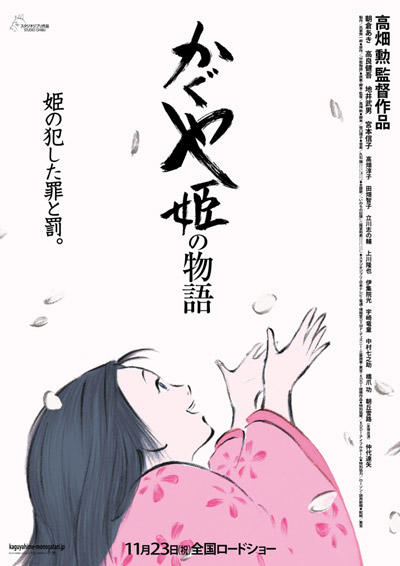
Begin with the deliberately wrong question: why does the picture look “unfinished”? White surrounds figures, contours sometimes refuse to close, and backgrounds arrive then dissolve as if the paper retained a right to silence. This is not a missing final coat. It is a complete system that asks your eye to finish the motion. When Kaguya runs, the film does not inventory every leaf and stone; direction, weight, and spacing of marks are enough, and what is not drawn becomes speed. The film does not copy an old handscroll frame by frame. It makes the act of drawing part of the drama.
1. Empty space is performance space, not vacant background. In the countryside, white lets bodies expand: a child rushes beyond the frame, a branch bends, a circle of friends grows without a wall sealing it. Later, as social life tightens around Kaguya, rigid architecture, a screen edge, or the measured distance between seated people is enough. Look at the space around the character before her face. Can she exit the shot? Is the white a route or a barrier? Composition becomes a story about how much freedom a body is allowed.
2. Line does not merely describe mood; it breathes with it. During play it is rounded and quick, as though the artist were catching up with motion. When the role of “princess” is imposed, the economy grows stricter: an upright back, a sleeve locating the hand, a measured bow. Under emotional pressure, marks splinter and strokes widen until the environment seems unable to hold still. No animation vocabulary is required. Is the line continuous or broken? Is its pressure even? Does the body stay inside its outline, or seem ready to spill beyond it?
3. Color knows when to be beautiful and when to become a burden. The mountain’s colors are warm but unpolished; brown and green belong to earth. In the capital, color arrives as a system—cloth, cosmetics, ornament, and rank announced before speech. The film does not simply call beauty false; some rituals are delicate and fabrics astonishing. Beauty hurts when it defines the person inside the body from outside. Adaptation therefore asks not only what happened in The Tale of the Bamboo Cutter, but what happening felt like in a body: a foot in mud, a call between children, a sleeve obstructing movement that once came naturally.
4. The accompanying Met image is a comparison window, not “proof of inspiration.” It is a page from a late-seventeenth-century Japanese illustrated book set, made with ink, color, gold, and silver on paper and released under CC0. It reveals another arrangement of figures, ornament, and breathing room around Kaguya’s story. Resemblance does not prove the film team copied this page. Responsible comparison notices a shared question—how can a story live on paper?—while respecting differences of period, medium, and purpose.
5. Sound prevents emptiness from becoming decoration. Joe Hisaishi’s score is present, but it is not poured over every moment to prescribe feeling. Cloth friction, footsteps, insects, and an off-screen group give white paper acoustic volume. Try one minute without looking—listen only—then replay it muted. The first pass reveals borders the frame did not draw; the second shows line carrying rhythm without a note. Together, music does not merely “complete” the picture. Sound and mark share responsibility for the world.
A four-pass exercise: choose a spoiler-safe sixty-second scene. First, watch normally and write down one feeling. Second, mute it and count shifts from light to heavy line. Third, stop following the face; watch edges, doors, and how much white the body can use. Fourth, restore sound and ask where rhythm begins—in music, a footstep, editing, or changing drawing density. Four different answers are not a failure. They show the film building meaning in layers rather than assigning dialogue all the work.
The takeaway: the film is powerful neither because it looks old nor because it proves hand drawing “better” than other techniques. It makes form ethically responsible to story: as Kaguya’s freedom expands, motion expands; as definitions are imposed, the body contracts or the line erupts. The film feels drawn now because it refuses to turn its heroine into a finished image society can hang on a wall. If it is not legally available in your region today, keep this guide and wait rather than substituting a pirate site.
Sources
Sources
Dates and availability can vary by territory. Time-sensitive claims link to their direct source.
- Studio Ghibli: official film page, credits, running time, and image-use notice
- Studio Ghibli: official Japanese release-date announcement
- Studio Ghibli: studio history and 2D-animation context
- GKIDS: official North American distributor page
- The Met: collection record for the illustrated Taketori monogatari
- National Diet Library: catalog record for an illustrated Tale of the Bamboo Cutter scroll
Continue the story
Related picks for anime fans
Explore manga, art books, drawing tools, and collectibles on Amazon.sa. As an Amazon Associate I earn from qualifying purchases, at no extra cost to you. Affiliate disclosure
As an Amazon Associate I earn from qualifying purchases.
An official home-video edition of the film
Verify disc region, format, audio, and subtitles before buying; no price or compatibility is promised.
Browse on Amazon.sa ↗02A film art book or storyboard collection
Useful for studying line and composition; verify publisher, language, and condition before ordering.
Browse on Amazon.sa ↗